Key Takeaways
- Lovable is the gold standard for non-technical founders: zero-to-one full-stack apps with automated Supabase schemas, auth, and two-way GitHub sync.
- Bolt.new (StackBlitz) delivers the fastest browser-native development speed via WebContainers, giving developers real file visibility and multi-framework freedom (React, Svelte, Vue, Astro).
- v0 (Vercel) remains the king of frontend design: pixel-perfect React, Tailwind, and shadcn/ui components that integrate seamlessly into existing Next.js production codebases.
- Replit Agent is the deepest end-to-end cloud workspace: autonomous agents running in full Linux containers supporting 50+ languages (Python, Go, Node.js) with integrated cloud hosting.
- Bottom line: Use Lovable to launch a startup MVP, v0 to design world-class screens, Bolt.new for rapid browser hacking, and Replit for persistent multi-language software.
In early 2024, "vibe coding" was a fun tech novelty. You typed a prompt, an AI spat out a basic HTML landing page with a broken contact button, and you still had to hire a freelance engineer to wire up a real database. Fast forward to late 2026, and the landscape has completely changed: AI app builders now provision relational databases, write authentication middleware, handle edge functions, and deploy live production apps to custom domains in under ten minutes.
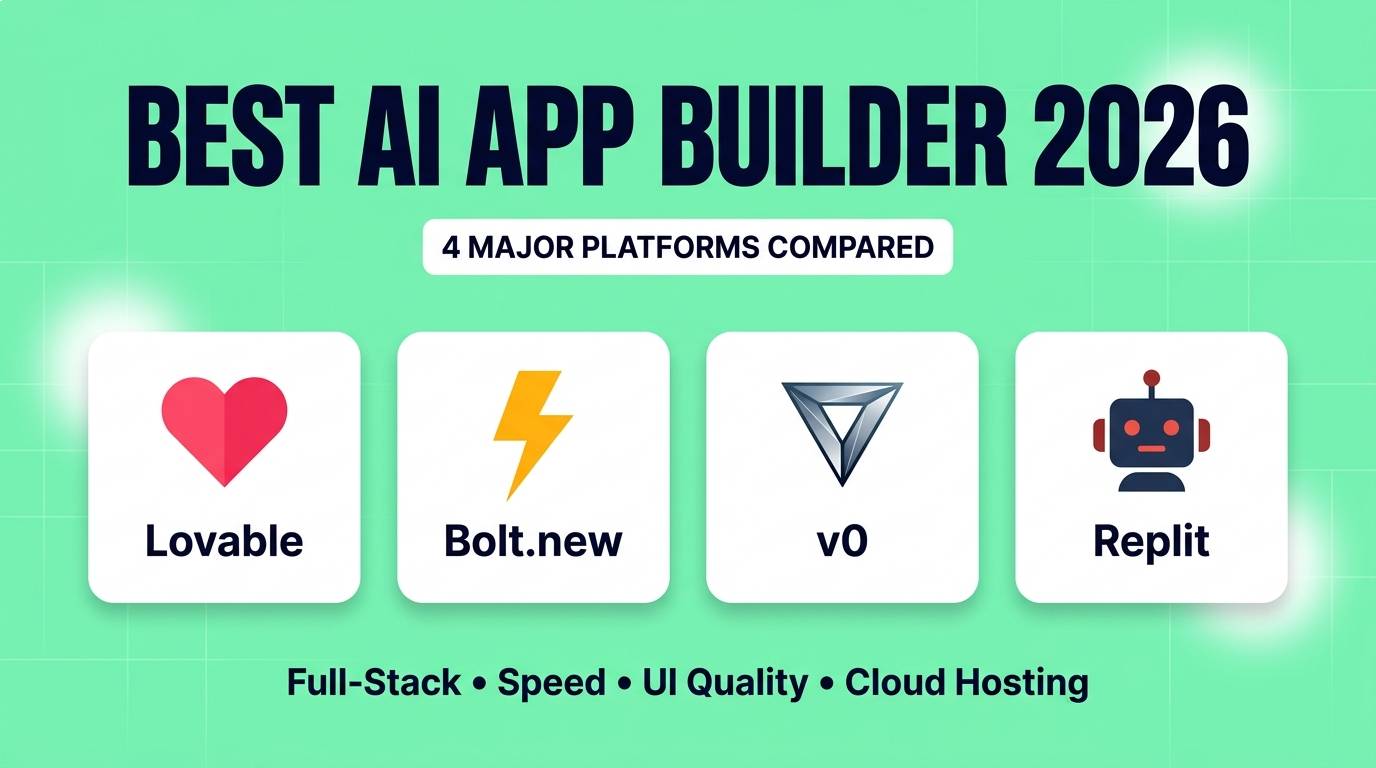
Four platforms dominate every conversation about AI-assisted software development: Bolt.new, Lovable, v0, and Replit Agent. While tech influencers claim you can build "the next Airbnb in an afternoon" with any of them, anyone who has built real software knows the truth: each of these platforms was designed for a fundamentally different builder.
To cut through the marketing noise, I spent four weeks building the exact same project on all four platforms: a functional SaaS customer feedback portal featuring user authentication, payment tiers, a relational PostgreSQL database, and an administrative analytics dashboard. Here is how they actually compare when things get complicated.
Quick Verdict: The 30-Second Answer
At a Glance
- Pick Lovable if: You are a solo founder, marketer, or product manager with minimal coding experience who needs a working full-stack MVP with database and login deployed today.
- Pick Bolt.new if: You know enough code to understand file structures and want instant, zero-setup scaffolding in a browser tab without managing local packages.
- Pick v0 if: You already have a backend or Next.js app and need gorgeous, production-ready shadcn/ui components that match enterprise design standards.
- Pick Replit Agent if: Your application needs a persistent server backend, Python data processing, custom background jobs, or deployment across non-JavaScript runtimes.
Feature & Specs Comparison Table
| Platform | Primary Focus | Backend & DB | Frameworks Supported | Code Portability | Starting Price |
|---|---|---|---|---|---|
| Lovable | Full-Stack SaaS MVPs | Automated Supabase (Postgres & Auth) | React, Tailwind, Vite | Excellent (GitHub Sync) | Free / $25/mo |
| Bolt.new | Fast Browser Development | Node.js Edge / Supabase | React, Vue, Svelte, Astro, Next.js | Excellent (Zip / GitHub) | Free / $25/mo |
| v0 by Vercel | UI & Component Design | Bring Your Own / Vercel KV | React, Next.js, shadcn/ui, Tailwind | Flawless (Copy/Paste & CLI) | Free / $20/mo |
| Replit Agent | Autonomous Full-Stack Systems | Built-in Postgres, Key-Value, SQLite | 50+ Languages (Python, Node, Go) | Moderate (Container export) | Free / $20/mo |
1. Lovable — The Non-Coder's MVP Machine
Lovable has taken the startup world by storm for a simple reason: it is the most cohesive "prompt-to-working-product" tool on the market. While early prompt-based coders built pretty web pages with fake dummy data, Lovable immediately sets up a real PostgreSQL database, configures user login tables, and provisions API routes through its seamless Supabase integration.
During testing, I typed: "Build a customer feedback portal with upvoting, comment threads, admin moderation, and a Stripe payment paywall for premium suggestions." In under 4 minutes, Lovable created the landing page, built the interactive board, created row-level security (RLS) policies in Supabase, and wrote client authentication hooks. When you ask it to make visual tweaks, its chat interface lets you click directly on any element in the live preview to isolate edits.
Another massive advantage is transparent code ownership. Every change made by Lovable's AI agent commits automatically to a connected GitHub repository in clean, idiomatic React and TypeScript. If you decide to hire a developer later, they can clone the repo and run it locally without unwrapping proprietary spaghetti code.
Where Lovable struggles: When your application requires highly unusual custom backend business logic or complex multi-step background worker queues, you can get caught in conversational prompt loops that burn through monthly credits.
Lovable Scores
2. Bolt.new — The Browser-Native Speed Demon
Created by StackBlitz, Bolt.new approaches the problem from a developer-first perspective. Instead of running code on remote cloud virtual machines, Bolt runs an entire sandboxed Node.js development runtime directly inside your browser tab via WebContainers technology. There is zero server provisioning lag: you type a prompt, and files appear, compile, and run in your preview window instantly.
Bolt's killer differentiator is framework flexibility. While competitors lock you into React, Bolt cheerfully builds full projects in SvelteKit, Vue (Nuxt), Astro, Vite, or Next.js. You can inspect the entire file tree (`package.json`, route components, utilities), open an embedded terminal window to install npm dependencies manually, and view compile errors in real time.
The addition of Figma import allows designers to paste Figma URLs directly into the chat prompt, which Bolt translates into responsive frontend layouts with surprising fidelity. Powered by frontier reasoning models like Claude 3.7 Sonnet and Opus, Bolt writes clean, modular components.
Where Bolt struggles: Bolt calculates credit consumption based on your entire repository context window. As your project grows from 5 files to 50 files, every single chat message sends the entire codebase back to the model, meaning token consumption accelerates rapidly on large repositories.
Bolt.new Scores
3. v0 by Vercel — The Frontend & UI Perfectionist
If you ask experienced engineering teams which tool they actually use in their daily workflow, the answer is almost always v0. Vercel did not attempt to build a clunky all-in-one app generator that guesses your database architecture. Instead, v0 focuses laser-sharp on one thing: writing the world's best modern frontend UI code.
Trained deeply on the modern frontend stack — React, Next.js App Router, Tailwind CSS, and shadcn/ui — v0 creates screens and design systems that look like they were crafted by senior product designers at Stripe or Linear. The typography hierarchy, micro-interactions, modal behaviors, and responsive breakpoints are consistently flawless.
v0 fits naturally into existing engineering pipelines. When you generate a dashboard or complex multi-step form, you can click "Add to Codebase" or copy the CLI command (npx v0 add component-name) to inject the component directly into your local Next.js project. You maintain full ownership over your backend APIs, databases, and business logic without wrestling with AI-generated database hallucinations.
Where v0 struggles: v0 is deliberately not an autonomous end-to-end backend builder. If you are a non-technical founder who wants an AI to automatically create database tables and wire up payment webhooks without opening an IDE, v0 expects you to bring your own backend.
v0 Scores
4. Replit Agent — The Full Cloud IDE & Infrastructure
Replit started a decade ago as a cloud collaborative IDE before adding autonomous AI agents — and that technical lineage gives it capabilities that pure browser tools cannot touch. When you task Replit Agent with building an application, it does not just write code into a file; it spins up a real, persistent Linux container, writes code, executes bash commands in the shell, reads terminal error output, self-corrects bugs, and keeps running indefinitely.
This architecture makes Replit the undisputed winner for complex, non-JavaScript backends. If you want to build an AI application using Python, LangChain, FastAPI, Flask, or Go — or if you need scheduled cron jobs, persistent socket connections, and local SQLite/PostgreSQL storage — Replit handles it effortlessly.
Deployment is completely native. With one click, Replit publishes your application to a live `.replit.app` domain (or custom domain) with autoscaling cloud hosting, SSL certificates, and environment secrets managed in one place.
Where Replit struggles: The learning curve is noticeably steeper than Lovable or Bolt. Replit exposes terminals, container status, and package managers. If you are a total beginner, the interface can feel overwhelming, and long agent debugging loops can deplete monthly checkpoint quotas quickly.
Replit Agent Scores
Head-to-Head: Backend, Portability & Pricing
1. The Backend Battle
Lovable wins for standard web apps by delegating backend heavy lifting to Supabase (auth, database, storage). Replit Agent wins if your app needs Python data science, web scrapers, or custom server processes. Bolt.new is great for mock backends and Node.js edge functions, while v0 expects you to handle your own backend architecture.
2. Code Portability & Vendor Lock-In
Nobody wants to spend three weeks building an app on a platform only to discover they can never leave. Both Lovable and Bolt.new generate standard, portable React code with direct GitHub synchronization. v0 exports pure, vanilla Tailwind and React components with zero proprietary lock-in. Replit code is portable, but its native hosting, key-value databases, and authentication hooks take more refactoring to migrate to AWS or Render.
3. Pricing & Token Burns
Pricing Reality in 2026: Most platforms hover around the $20-$25/month mark for solo builders (Lovable Pro at $25/mo, Bolt.new Pro at $25/mo, v0 Premium at $20/mo, and Replit Core at $20/mo). The true cost differentiator is token burn rate: Lovable uses credit-based actions that are predictable, while Bolt and Replit can burn through tokens rapidly if you prompt the agent to analyze large repositories over long sessions.
Overall Scores Breakdown
Lovable
Bolt.new
v0
Replit Agent
Which One Should You Choose?
The Definitive 2026 Buying Guide
- Choose Lovable if: You are a non-technical entrepreneur, agency lead, or product creator who wants to build a commercial SaaS MVP with user accounts and database tables without writing code.
- Choose Bolt.new if: You are a developer or designer who wants zero-friction project scaffolding, framework flexibility (Vue, Svelte, Astro), and the ability to turn Figma designs into living browser code.
- Choose v0 if: You already write React/Next.js code and want a world-class copilot to generate stunning dashboards, landing sections, and accessible UI components in seconds.
- Choose Replit Agent if: Your product relies on Python, background data pipelines, complex server logic, or you want your IDE, agent, and production hosting united under one roof.
Frequently Asked Questions
Can you really build a production SaaS without knowing how to code in 2026?
Yes, for straightforward MVPs. Platforms like Lovable and Replit Agent can successfully generate user registration, database schema relations, payment checkouts (Stripe), and UI dashboards from plain language. However, builders must still understand basic data logic, user permissions, and security rules before handling real customer payment data.
Is Lovable better than Bolt.new?
For non-technical builders, yes: Lovable provides a much more guided, cohesive path to a deployed app with database and authentication pre-configured via Supabase. For developers, Bolt.new is often preferred because it runs in browser WebContainers, supports multiple frameworks like Svelte and Vue, and gives instant file-level control.
Why do professional developers prefer v0 over full app builders?
Professional software engineers rarely want an AI agent generating uncontrolled backend architectures. v0 focuses exclusively on producing clean, accessible React and Tailwind components using standard shadcn/ui patterns that developers can copy directly into existing production codebases.
Can I export my code and host it elsewhere?
Yes. All four platforms allow you to export your source code. Lovable and Bolt.new integrate with GitHub for automatic commits. v0 allows one-click CLI imports, and Replit projects can be downloaded as standard repositories to host on Vercel, Netlify, Render, or AWS.
What is the power-user combo in 2026?
Many power creators use a two-step workflow: use v0 to generate pristine, bespoke UI screens and component designs, then paste those components into Lovable, Bolt.new, or Cursor to hook them into live database APIs and backend logic.
The golden age of software creation is officially here. Stop debating the hype and start building: pick the tool that matches your technical comfort level today, ship your first version, and let real user feedback guide your next iteration.
Curious about more AI coding tools, agents, and frameworks? Explore our complete AI tools directory for 100+ verified software reviews.