Key Takeaways
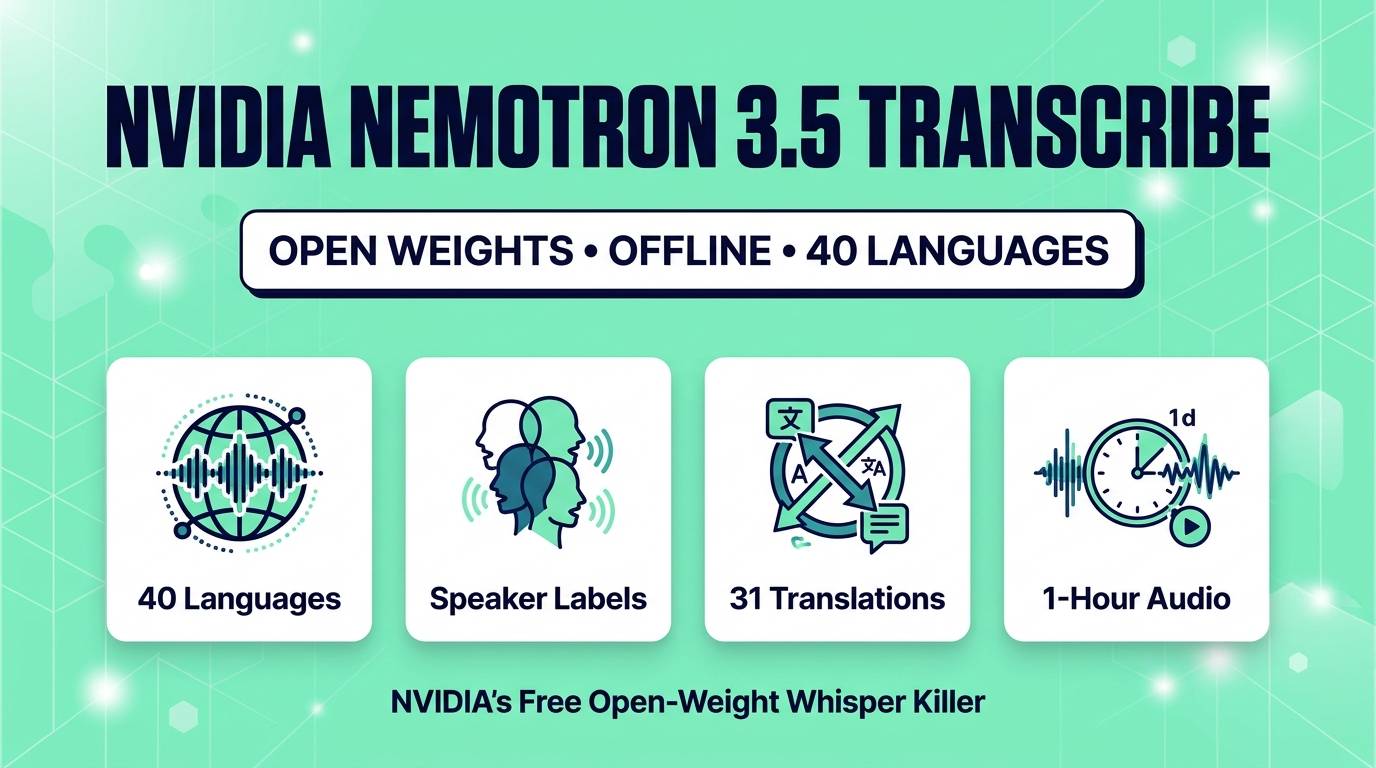
- Open-Weight Speech Giant: NVIDIA released Nemotron 3.5 Transcribe (34B total parameters, 4.3B active MoE) alongside a lightweight 0.6B Streaming ASR model under the commercial-friendly OpenMDW-1.1 license.
- All-in-One Pipeline: It combines transcription in 40 languages, speech translation across 31 languages, native speaker diarization (up to 8 speakers in 13 languages), and direct Audio Q&A in a single model.
- 60-Minute Context Window: Processes up to 1 full hour of audio (65,536 tokens) in one pass without the 30-second chunking headaches of OpenAI Whisper.
- New Accuracy King: Beats Whisper Large-v3, Qwen3-ASR-1.7B, and Parakeet-TDT on the Open ASR Leaderboard with a 4.71% English WER and 4.62% Multilingual WER.
For the last three years, OpenAI's Whisper has been the default answer whenever someone asked for free, open-source speech-to-text. But anyone who has actually used Whisper in production knows its secret frustrations: it only sees 30 seconds of audio at a time, it cannot tell who is speaking without bolting on clunky third-party diarization scripts like Pyannote, and it routinely misspells company names, acronyms, and technical jargon.
This week, NVIDIA blew up that entire fragile pipeline. With the release of NVIDIA Nemotron 3.5 Transcribe (and the massive 463,000-hour Granary v2 open speech dataset), NVIDIA did not just release another speech recognizer — they shipped an open-weight Speech-Augmented Language Model (SALM) that transcribes, translates, identifies speakers, follows style instructions, and answers questions about 60-minute audio files in a single pass.
Here is everything you need to know about Nemotron 3.5 Transcribe, how it compares to Whisper, and how you can run the family offline or via pennies-per-hour APIs today.
What Is NVIDIA Nemotron 3.5 Transcribe?
Traditional speech-to-text models are "acoustic-only" — they map sound waves to words and stop there. If you want speaker labels, punctuation formatting, PII redaction, or summaries, you have to chain three or four different AI models together.
Nemotron 3.5 Transcribe replaces that entire chain with a single Speech-Augmented Language Model (SALM). Under the hood, it pairs a Parallel Expert Audio Encoder (combining a Transformer ASR encoder and a dedicated speaker encoder) with a Mamba-2–Transformer hybrid Mixture-of-Experts (MoE) language model.
While the full model holds roughly 34 billion parameters (including the audio encoders), its MoE design means only 4.3 billion parameters activate on any given step. That gives you the deep linguistic intelligence of a massive LLM with the inference speed and footprint of a compact 4B model.
Two Flavors: 30B File Transcribe vs 0.6B Live Streaming
NVIDIA smartly recognized that developers and creators have two completely different hardware budgets and use cases, so the Nemotron 3.5 speech release actually comes in two shapes:
| Model | Total / Active Params | Best For | Languages | Hardware Target |
|---|---|---|---|---|
| Nemotron 3.5 Transcribe | 34B Total / 4.3B Active | Recorded files up to 60 mins, speaker labels, translation, Q&A | 40 Languages | Workstation / Server GPU (BF16, FP8, NVFP4) |
| Nemotron 3.5 ASR Streaming | 0.6B (600M Params) | Real-time live captioning, local PC offline use, voice agents | 40+ Languages | Consumer GPUs & Laptops |
Which one should you grab for local offline use? If you have a normal consumer PC or laptop and want instant offline dictation or live subtitling, grab Nemotron 3.5 ASR Streaming 0.6B — at just 600 million parameters, it runs effortlessly on everyday hardware. If you have a heavy workstation GPU (or use quantized NVFP4/FP8 weights), run the full 30B-A4B Transcribe model.
5 Features That Make Old ASR Tools Obsolete
Why is the AI community calling this the biggest speech release since Whisper? Because of five built-in capabilities that used to require paid SaaS tools:
1. True 40-Language Transcription (Including Code-Switching)
In real life, bilingual speakers do not stick to one language — they mix English words into French, Arabic, Spanish, or Hindi mid-sentence. Most ASR models panic when this happens. Nemotron 3.5 handles mid-sentence language switching naturally across 40 languages and achieves a record-breaking 4.62% Mean Word Error Rate (WER) on the Multilingual Open ASR Leaderboard.
2. Built-In Speaker Diarization in 13 Languages
No more wrestling with Pyannote tokens or Hugging Face gated repos. Nemotron 3.5 Transcribe has a dedicated speaker encoder baked directly into the model. It automatically identifies and attributes up to 8 distinct speakers across 13 major languages: Arabic, Mandarin, English, French, German, Hindi, Italian, Japanese, Korean, Portuguese, Russian, Spanish, and Thai.
3. Prompt-Guided Vocabulary & Formatting
Because it is an instruction-following model, you send a short text prompt alongside your audio file. You can pass a custom list of product names, medical terms, client names, or acronyms so the model spells them exactly right every time. You can also tell it whether you want strict verbatim transcription (keeping every "um" and "uh") or clean written form ready for publication.
4. Full 1-Hour Recordings Without Chunking
With a 65,536-token context window, you can drop an entire 60-minute podcast episode, lecture, or client meeting into the model at once. Because it sees the whole hour, it maintains context and speaker identities from minute 1 to minute 60.
5. Direct Audio Q&A and PII Redaction
You do not even have to transcribe the file first if you just want answers. Turn on enable_thinking=True in the chat template and ask questions directly about the audio recording, or instruct the model to automatically tag and redact sensitive Personally Identifiable Information (PII) like phone numbers and addresses during transcription.
Head-to-Head: Nemotron 3.5 vs Whisper v3 Turbo vs Qwen3-ASR
Here is how NVIDIA's new flagship stacks up against the most popular open-weight speech models in October 2026:
| Feature / Benchmark | Nemotron 3.5 Transcribe | Whisper Large-v3 Turbo | Qwen3-ASR-1.7B |
|---|---|---|---|
| Architecture | 34B MoE (4.3B Active) SALM | 809M Encoder-Decoder | 1.7B Audio-LLM |
| Max Single-Pass Audio | 60 Minutes | 30 Seconds (chunked) | ~15 Minutes |
| English Open ASR WER ↓ | 4.71% (Best) | ~5.60% | 4.94% |
| Multilingual WER ↓ | 4.62% (Best) | ~7.80% | 6.49% |
| Native Speaker Labels | ✅ Yes (Up to 8 speakers) | ❌ No (Needs external tool) | ❌ No |
| Speech Translation | ✅ 31 Languages (Bi-directional) | Only to English | Limited |
| Custom Vocabulary Prompt | ✅ Full instruction adherence | Very limited (224 tokens) | ✅ Good |
| Commercial License | ✅ OpenMDW-1.1 | ✅ MIT | ✅ Apache 2.0 |
Hardware Reality Check: How to Use It for Free (or Nearly Free)
Let us be 100% transparent about hardware requirements so you do not waste time downloading 60GB of weights onto a laptop that cannot run them:
- For Everyday Laptops & Consumer GPUs (100% Free Offline): Use the Nemotron 3.5 ASR Streaming 0.6B model via NVIDIA NeMo. It is tiny, supports 40+ languages, and runs completely offline on standard consumer hardware.
- For Local Workstations & Home Labs (100% Free Offline): The full 34B (4.3B active) Transcribe model in full BF16 precision targets an 80GB enterprise GPU. However, NVIDIA also released FP8 and NVFP4 (4-bit quantized) variants that drastically slash VRAM requirements down to ~20-24GB for enthusiasts with an RTX 3090, 4090, or 5090 running vLLM.
- No Heavy GPU? Cloud API Cost Is Practically Zero: Because only 4.3B parameters are active, cloud providers like OpenRouter host
nvidia/nemotron-3.5-transcribefor $0.000033 per second (that is roughly $0.12 for a full hour of audio — over 10x cheaper than paid transcription SaaS platforms) and you can test it free in NVIDIA's browser playground.
Insane Speed Benchmark
Using NVIDIA's NVFP4 weights with DFlash2 speculative decoding, a single Blackwell GPU transcribes 2,238 seconds of audio per second — returning the transcript of a 30-second audio clip in just 0.13 seconds.
Nemotron 3.5 Transcribe Scores
Frequently Asked Questions
Is NVIDIA Nemotron 3.5 Transcribe free for commercial use?
Yes. NVIDIA released the model weights under the permissive OpenMDW-1.1 license, which explicitly permits both non-commercial and commercial deployment, customization, and fine-tuning at zero licensing cost.
What languages does Nemotron 3.5 Transcribe support for speaker identification?
While the model transcribes 40 languages and translates 31 languages to and from English, native speaker diarization (identifying up to 8 speakers) is supported across 13 major languages: Arabic, Mandarin, English, French, German, Hindi, Italian, Japanese, Korean, Portuguese, Russian, Spanish, and Thai.
Can I run Nemotron 3.5 Transcribe offline on my own computer?
Yes, it is an offline open-weight model. For everyday consumer PCs, use the lightweight Nemotron 3.5 ASR 0.6B model. To run the flagship 30B-A4B Transcribe model locally, you will need a workstation GPU (using the NVFP4 or FP8 quantized weights via vLLM/NeMo) as full BF16 precision requires enterprise VRAM.
Why is Nemotron 3.5 better than OpenAI Whisper for long meetings?
Whisper processes audio in isolated 30-second windows, which often causes hallucinations during silence and requires separate models to detect speakers. Nemotron 3.5 processes up to 1 full hour of audio in a single 65K-token context window with native speaker attribution and custom vocabulary prompting.
Final Verdict
The Bottom Line
NVIDIA Nemotron 3.5 Transcribe marks the moment speech recognition graduated from dumb acoustic transcription to true audio intelligence. By uniting 40-language transcription, 31-language translation, 8-speaker diarization, and custom prompt instructions inside a fast 4.3B-active MoE architecture, NVIDIA has handed developers and creators an open-weight powerhouse that beats paid proprietary APIs.
Looking for more free AI audio and voice tools? Check out our full AI tools directory for 100+ tested and ranked platforms.