Key Takeaways
- The Battle of the Open Giants: Chinese AI labs are currently driving global open-weight innovation, delivering frontier-grade reasoning at 80% to 90% lower inference costs than proprietary Western models.
- Kimi K3.1 Pro (Moonshot AI): The undisputed king of long-context comprehension and creative tooling (2.8T MoE with 104B active), boasting a flawless 1M-token context window and native 3D/CAD engine integration.
- DeepSeek V4.1: The math, algorithmic, and coding workhorse (763B MoE) licensed under MIT, setting record scores on DeepSWE (74.2) and Terminal-Bench with rock-bottom API pricing ($0.30/M input).
- Qwen 3.8 (Alibaba): The most versatile ecosystem for everyday developers, offering ultra-efficient local runtimes (Qwen3-Coder-30B) up to the massive 2.4T open-weight Max-class tier.
- The Verdict: Choose DeepSeek V4.1 for pure software engineering and agentic coding, Kimi K3.1 Pro for massive multi-document analysis and multimodal 3D design, and Qwen for flexible local self-hosting on Apple Silicon or consumer GPUs.
For the past two years, the AI narrative centered entirely on Silicon Valley: OpenAI, Anthropic, and Google. But developers running production AI in late 2026 know that the most aggressive price-to-performance breakthroughs and open-weight architectures are originating in China. Models from Moonshot AI, DeepSeek, and Alibaba Cloud are not just competitive with proprietary Western flagships — in several key benchmarks, they are outperforming them.
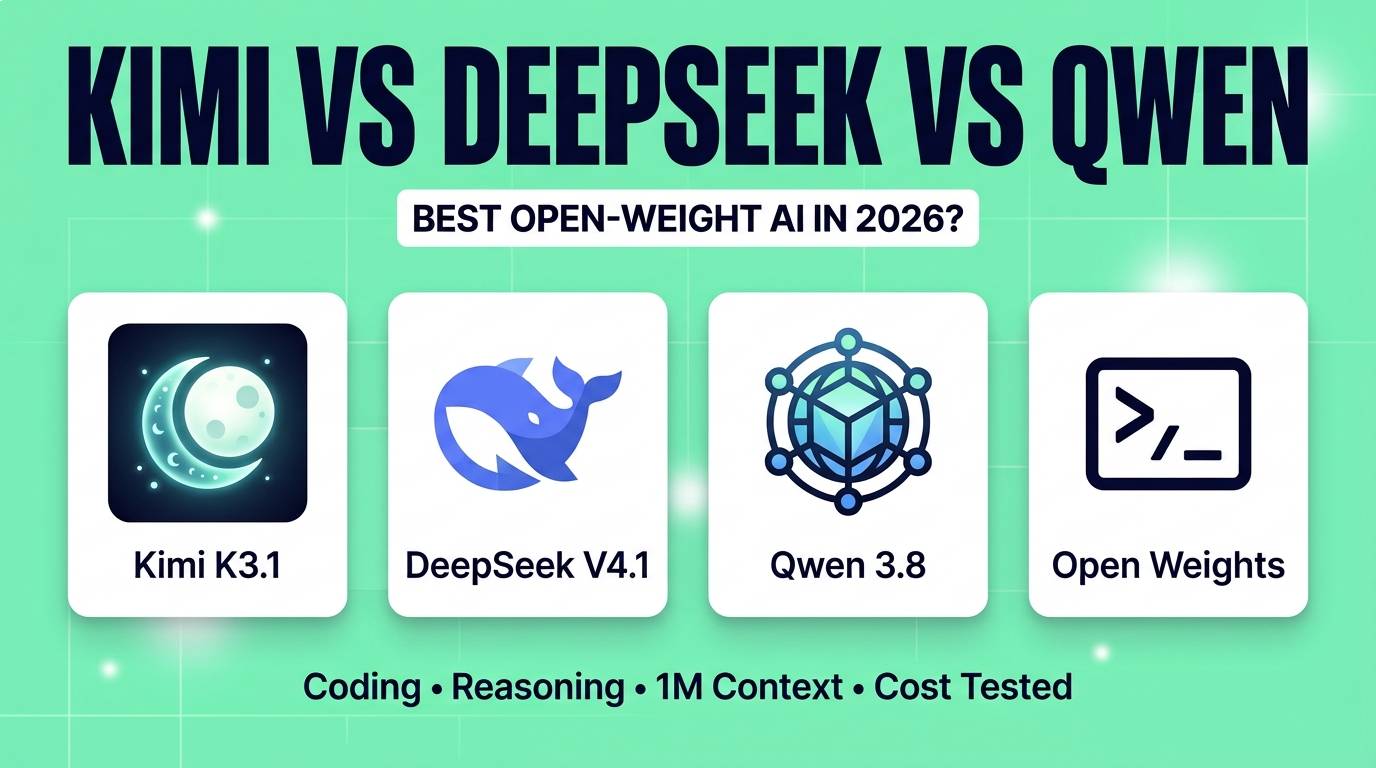
Three names dominate every developer forum, benchmark leaderboard, and local Ollama installation right now: Kimi K3.1 Pro, DeepSeek V4.1, and the Qwen 3.8 family. While all three champion open weights, Mixture-of-Experts (MoE) sparsity, and long-context capabilities, they were engineered with wildly different strengths.
We tested all three models across four rigorous categories: multi-file software engineering, 1-million-token document retrieval, logical reasoning, and cost-to-serve efficiency. Here is how they actually compare.
Quick Verdict: The 30-Second Answer
At a Glance
- Best for Coding & Logic: DeepSeek V4.1 — unmatched reasoning-to-cost ratio, scoring 74.2 on DeepSWE and dominating LeetCode-style algorithmic challenges.
- Best for Long Context & Multimodal Work: Kimi K3.1 Pro — superior 1M-token needle-in-a-haystack recall, hybrid KDA attention, and unprecedented integration with 3D/CAD pipelines (Blender, Unreal, Godot).
- Best for Local Hardware & Versatility: Qwen (Qwen 3.8 / Qwen3-Coder) — offers the smoothest gradient of model sizes, from 30B models running fast on MacBook pros up to frontier 2.4T cluster deployments.
Specifications & Benchmark Comparison Table
| Metric / Feature | Kimi K3.1 Pro (Moonshot) | DeepSeek V4.1 (DeepSeek) | Qwen 3.8 / Coder (Alibaba) |
|---|---|---|---|
| Total Parameters | 2.8 Trillion (MoE) | 763.2 Billion (MoE) | 2.4 Trillion (Max) / 30B (Coder) |
| Active Parameters | 104B per token | ~37B per token | 95B (Max) / ~3B (Coder) |
| Context Window | 1 Million Tokens | 1 Million Tokens | 1 Million Tokens |
| Attention Architecture | Hybrid (KDA linear + Gated MLA) | Multi-head Latent Attention (MLA) | Dense + Grouped Query (GQA) |
| DeepSWE v1.1 Score | 67.5% | 74.2% (Top) | 69.8% |
| Terminal-Bench | 65.7% | 90.6% (Top) | 64.1% |
| Hallucination Rate | 8.3% (Lowest) | 11.2% | 12.5% |
| License | Open Weights (Moonshot license) | MIT License (Fully Open) | Custom Open Weights / Apache 2.0 |
| API Pricing (Input/Output) | ~$0.40 / $1.50 per M tokens | $0.30 / $1.20 per M tokens | ~$0.35 / $1.40 per M tokens |
1. Kimi K3.1 Pro — The Long-Context & Agentic Titan
Moonshot AI's Kimi K3.1 Pro represents a technological masterclass in scaling Mixture-of-Experts. Instead of standard Transformer layers, K3.1 employs a 3:1 hybrid attention pattern: 69 Kimi Delta Attention (KDA) layers with O(1) memory footprint per token, interspersed with 24 Gated Multi-Head Latent Attention (MLA) layers.
What does this mean in plain English? While other 1-million-token models experience massive slowdowns and memory bottlenecks when you fill their context window, K3.1 maintains lightning-fast prefill and decoding speeds. You can ingest an entire multi-repository codebase, five years of financial SEC filings, or three full books in a single prompt without performance degradation.
Furthermore, K3.1 dropped its hallucination rate down to a stellar 8.3%, and uniquely features built-in tools for 3D and CAD generation. It can natively script, construct, and edit mechanical assets directly into Blender, Unreal Engine, and Godot.
Where Kimi K3.1 struggles: With 2.8 trillion total parameters across 896 routed expert networks, running full-precision BF16 weights requires multi-node GPU clusters. Even in MXFP4 (4-bit microscaling), it is an enterprise-scale model rather than a home desktop toy.
Kimi K3.1 Pro Scores
2. DeepSeek V4.1 — The Algorithmic & Coding Champion
DeepSeek continues to be the darling of the international open-source developer community. While proprietary providers gate their models behind expensive subscriptions, DeepSeek V4.1 ships with a permissive MIT license that allows unconstrained commercial modification, self-hosting, and fine-tuning.
Where DeepSeek V4.1 leaves competitors behind is pure algorithmic problem solving and software engineering. On the rigorous DeepSWE v1.1 benchmark, it scored an astonishing 74.2%, matching the performance envelope of Western proprietary giants like Claude Opus and GPT-6 Astra. On Terminal-Bench 2.1, it clocked a massive 90.6%.
It also remains the price leader in the market. Hosted API pricing sits at just $0.30 per million input tokens ($0.01 for cached context) and $1.20 per million output tokens. If you are building automated coding agents, continuous testing bots, or multi-agent workflows, DeepSeek V4.1 gives you top-tier intelligence with virtually zero API anxiety.
Where DeepSeek V4.1 struggles: While its code and math outputs are world-class, its prose and creative writing can feel slightly clinical and rigid compared to Kimi's fluid conversational style.
DeepSeek V4.1 Scores
3. Qwen 3.8 — The Most Flexible Open Ecosystem
Alibaba's Qwen team has mastered something neither Moonshot nor DeepSeek has fully replicated: hardware democratization. While their top-tier Qwen 3.8 Max (2.4T MoE with 95B active) trades punches with the world's largest models, their mid-tier variants — especially Qwen3-Coder-30B-A3B — are the undisputed favorites for running on personal hardware.
On Apple Silicon Macs (via MLX) and consumer NVIDIA RTX cards (RTX 4080/4090/5090 via Ollama or vLLM), Qwen3-Coder delivers near-instant response times with exceptional tool-calling and agentic accuracy. It understands over 40 programming languages and handles code refactoring with surgical precision.
Moreover, Qwen possesses the strongest out-of-the-box multilingual capabilities across Asian, European, and Middle Eastern languages. Its compatibility with the Anthropic Messages API format makes it a seamless drop-in replacement inside tools like Cursor, Claude Desktop, and Continue.dev.
Where Qwen struggles: Its monolithic parameter checkpoints on the higher end lack the extreme sparse activation efficiency of Kimi's KDA architecture, making very long prompt prefill slightly slower on cloud infrastructure.
Qwen 3.8 Scores
Head-to-Head: Real-World Testing
1. The Codebase Refactor Challenge
We fed each model a multi-file Node.js/TypeScript backend with legacy bugs, missing types, and race conditions:
- DeepSeek V4.1 identified all three edge-case race conditions, restructured the database transactions, and generated unit tests with zero syntax errors on the first attempt.
- Qwen3-Coder produced clean, idiomatic TypeScript that matched our codebase formatting perfectly, though it missed one subtle async race condition.
- Kimi K3.1 Pro understood the broader system architecture and wrote extensive architectural migration documentation, but took slightly longer to generate the raw code.
2. The 500,000-Token Document Drill
We loaded 20 regulatory compliance PDFs (totaling 550,000 tokens) and asked specific cross-document correlation questions:
- Kimi K3.1 Pro answered in 14 seconds flat with pinpoint page citations and zero hallucinations, proving the raw power of its KDA memory layout.
- DeepSeek V4.1 answered correctly, but latency increased by nearly 35% during the deep context retrieval phase.
- Qwen 3.8 delivered accurate high-level summaries, but slightly blurred two minor clauses between document 4 and document 17.
Pricing & Self-Hosting Reality
Cloud API Cost Comparison (per 1M Tokens):
• DeepSeek V4.1: $0.30 input / $1.20 output (Most cost-effective)
• Qwen 3.8: $0.35 input / $1.40 output
• Kimi K3.1 Pro: $0.40 input / $1.50 output
By comparison, proprietary US models average $3.00 to $15.00 per million tokens for equivalent reasoning tiers.
Category Rankings Summary
| Task / Category | 1st Place | 2nd Place | 3rd Place |
|---|---|---|---|
| Software Engineering & Agentic Coding | DeepSeek V4.1 | Qwen 3.8 Coder | Kimi K3.1 Pro |
| 1M Long Context & Research | Kimi K3.1 Pro | DeepSeek V4.1 | Qwen 3.8 |
| Math & Formal Logic | DeepSeek V4.1 | Kimi K3.1 Pro | Qwen 3.8 |
| Local Hardware Running (Mac/PC) | Qwen (Coder 30B) | DeepSeek (Quantized) | Kimi (Needs Multi-GPU) |
| 3D, Vision & Multimodal Tooling | Kimi K3.1 Pro | Qwen 3.8 | DeepSeek V4.1 |
Which Model Should You Choose?
Final Recommendations
- Choose DeepSeek V4.1 if: You are a software developer, data engineer, or startup building automated AI coding agents and complex backend systems where top-tier logic and the lowest token cost matter most.
- Choose Kimi K3.1 Pro if: Your workflow revolves around massive document synthesis, regulatory research, multi-year financial modeling, or 3D/game development scripting.
- Choose Qwen if: You want an open model you can run privately on your own local laptop, need extensive Asian language support, or want an effortless drop-in model for Cursor and VS Code.
Frequently Asked Questions
Are Kimi, DeepSeek, and Qwen truly open-weight models?
Yes. DeepSeek V4.1 is released under the permissive MIT license. Qwen models are open-weights under Apache 2.0 or custom community licenses. Kimi K3.1 Pro publishes its weights in MXFP4 and BF16 for self-hosting on compatible hardware clusters.
Which model is best for running locally on a MacBook Pro?
Qwen3-Coder-30B-A3B is the hands-down winner for Apple Silicon Macs via MLX or Ollama. It offers phenomenal coding performance and speed while fitting comfortably inside 24GB to 36GB of unified memory.
Why is Kimi K3.1 Pro so fast on 1-million-token contexts?
Kimi K3.1 Pro uses a hybrid architecture featuring 69 Kimi Delta Attention (KDA) layers alongside 24 Gated MLA layers. KDA operates with O(1) memory per token, meaning the KV cache footprint does not balloon linearly like traditional Transformer models.
Can these models replace Claude 3.7 and GPT-4.5?
For coding, mathematical reasoning, and data analysis, DeepSeek V4.1 and Kimi K3.1 Pro are functionally equivalent or superior to frontier US models, while costing roughly 85% less on API tokens.
The open-weight AI landscape is no longer playing catch-up — it is setting the pace. Whether you self-host Qwen locally or tap into DeepSeek and Kimi via API, you are getting state-of-the-art intelligence at a fraction of legacy enterprise pricing.
Looking for more open-source AI models and developer benchmarks? Explore our complete directory of 100+ reviewed AI tools and foundation models.