Key Takeaways
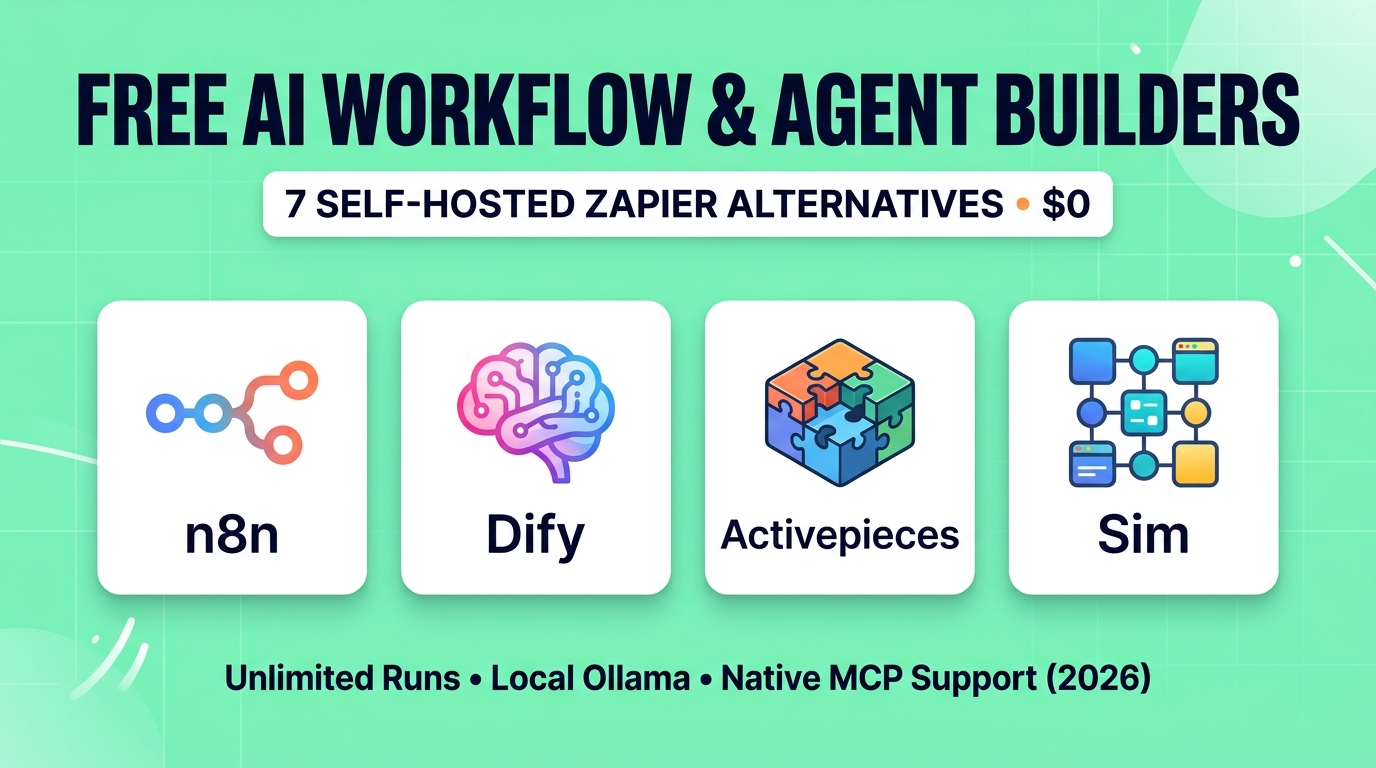
- Escape the Per-Task Tax: Commercial automation tools like Zapier and Make punish you as you scale, billing for every loop, webhook, and AI step. Self-hosted open-source builders give you unlimited executions for $0.
- n8n (v2.43+): The undisputed king of app-to-app automation, featuring 500+ integrations, LangChain AI Agent nodes, vector stores, and native MCP server/client support.
- Dify (v1.17+): The #1 platform for turning visual AI workflows and RAG knowledge bases into production web apps, APIs, or embeddable chatbots.
- Activepieces (MIT License): The cleanest, most beginner-friendly Zapier replacement with a true permissive MIT core, AI copilot flow builder, and 280+ pre-built pieces.
- Sim (Apache 2.0 Core): The fastest-growing collaborative AI agent workspace of late 2026, combining visual agent blocks, built-in tables, knowledge bases, and MCP deployment in one Docker command.
If you have ever built an automated AI pipeline on Zapier or Make, you know how quickly the bill spirals out of control. A single workflow that scrapes a webpage, summarizes it with an LLM, updates a CRM row, and sends a Slack alert can consume 10 to 15 "tasks" per run. Multiply that by a few hundred leads a day, and you are suddenly paying $100 to $300 a month just to connect APIs together.
Even worse, sending sensitive customer records, internal PDFs, and proprietary prompts through third-party automation clouds creates massive privacy bottlenecks.
In late 2026, the open-source ecosystem has completely overtaken closed SaaS builders. Whether you want to connect local Ollama models to 400+ business apps, build multi-agent RAG assistants, or expose custom tools to Claude and Cursor via MCP, you can self-host world-class automation engines on a $5 VPS or your local PC for $0 in software fees.
Note: With legacy projects like Flowise officially archived in late 2026, it is more important than ever to bet on actively maintained platforms. We tested the top contenders to bring you the 7 best free open-source AI workflow and agent builders in 2026.
Quick Comparison Table: Licenses, MCP & Best Use Case
| Platform | Primary Strength | MCP Support | Local Ollama | Core License | Self-Host Cost |
|---|---|---|---|---|---|
| n8n (v2.43+) | App triggers, webhooks & AI agents | ✅ Server & Client | ✅ Yes | Sustainable Use (Fair-Code) | $0 (Unlimited runs) |
| Dify (v1.17+) | RAG knowledge apps & chatbots | ✅ Server & Client | ✅ Yes | Modified Apache 2.0 | $0 (Community Ed.) |
| Activepieces | No-code business & AI workflows | ✅ Native MCP | ✅ Yes | MIT License (True OSS) | $0 (Community Ed.) |
| Sim | Collaborative AI agents + DB tables | ✅ Built-in MCP | ✅ Yes (Ollama/vLLM) | Apache 2.0 Core | $0 (npx sim-setup) |
| Langflow (v1.12+) | Python visual graphs & MCP tools | ✅ Every flow = MCP | ✅ Yes | MIT License (True OSS) | $0 (pip / Docker) |
| Windmill | Ultra-fast TS/Python scripts + AI | ✅ Yes | ✅ Yes | AGPL-3.0 | $0 (Self-Hosted) |
| Agenta | Sandboxed computer/browser agents | ✅ Yes | ✅ Yes | MIT License (True OSS) | $0 (Docker / Helm) |
1. n8n — Best Overall App & AI Workflow Automation Engine
If your goal is to connect real-world software — Gmail, Telegram, Google Sheets, Postgres, WordPress, Stripe, YouTube, or custom webhooks — with autonomous AI reasoning, n8n remains the undisputed heavyweight champion.
Unlike pure prompt-chaining tools that struggle when you need to parse a webhook or loop through 500 database rows, n8n gives you deterministic workflow control alongside dedicated AI Agent nodes. You can attach sub-nodes for chat memory, Qdrant/Supabase vector stores, JavaScript/Python code execution, and local Ollama models.
In its late-2026 releases, n8n also introduced native MCP (Model Context Protocol) Client and Server nodes — meaning you can expose any n8n workflow directly as a tool inside Claude Desktop, Cursor, or Roo Code in two clicks.
Licensing note: n8n's Community Edition is completely free to self-host with unlimited workflow executions for internal business or personal automation, though its Sustainable Use License restricts reselling n8n itself as a hosted multi-tenant SaaS.
n8n Scores
2. Dify — Best for RAG Apps, Chatbots & AI Product Deployment
While n8n is built around background automation triggers, Dify is engineered specifically for building and deploying user-facing AI applications. If you want to upload 200 company PDFs, build a multi-step research agent, and publish it as a clean web app or REST API in 15 minutes, Dify is unbeatable.
Dify includes a complete, production-ready RAG (Retrieval-Augmented Generation) pipeline right out of the box — handling document chunking, reranking, hybrid vector search, and citation tracking without forcing you to wire up external databases manually. Its visual canvas supports conditional branching, parallel iteration, sandboxed Python/Node code nodes, and instant conversion of any workflow into an MCP server.
Dify Scores
3. Activepieces — Best MIT-Licensed Zapier Replacement
If n8n's dense node graph feels intimidating to non-technical teammates — or if your startup requires a 100% OSI-approved MIT license with zero commercial restrictions — Activepieces is the #1 choice.
Activepieces mirrors Zapier's clean, vertical step-by-step builder while packing serious AI capabilities under the hood: native AI agents, human-in-the-loop approval buttons (so an agent pauses and asks you on Slack before sending an email or refund), and full MCP compatibility across its 280+ app connectors.
Activepieces Scores
4. Sim — Best Collaborative Multi-Agent Workspace
One of the biggest open-source breakout hits of late 2026 is Sim. Traditional workflow builders force you to bolt on external databases like Airtable or Postgres just so your AI agent can remember state between runs. Sim solves this by giving your agents built-in structured Tables, shared File storage, and synced Knowledge Bases directly inside the same workspace.
Licensed under Apache 2.0 for its core platform, Sim lets you design multi-agent flows visually on a canvas, generate workflows conversationally via chat, or manage them from your terminal CLI. With a single command (npx sim-setup), its interactive wizard spins up Docker containers and connects local Ollama or vLLM models in minutes.
Sim Scores
5. Langflow — Best Python-Extensible Visual Agent & MCP Builder
With Flowise officially archived in August 2026, Langflow (MIT License) is now the undisputed champion for Python developers who want a visual drag-and-drop canvas without sacrificing code control. Click "Code" on any visual block in Langflow and you can edit its underlying Python class live on the spot.
6. Windmill — Best High-Speed Developer Engine (Code + AI)
When low-code visual builders feel too slow or restrictive for heavy data processing, Windmill bridges the gap: write normal TypeScript or Python scripts, and Windmill automatically chains them into visual DAG workflows, exposes them as AI tool calls, and generates clean internal admin dashboards around them.
7. Agenta — Best Open-Source Agent Harness With Browser Sandbox
Unlike traditional API-only workflow tools, Agenta (MIT License) equips every self-hosted agent with an isolated sandboxed computer and web browser — allowing marketing, ops, and research teams to automate websites that do not even have an API.
How to Run Your AI Automations With $0 Token Costs
The 100% Free Self-Hosted AI Stack:
1. Install Ollama on your server or PC and pull a strong tool-calling model: ollama pull qwen2.5:14b (or qwen3-coder).
2. Spin up n8n, Dify, Activepieces, or Sim via Docker Compose.
3. Set your LLM provider base URL to http://host.docker.internal:11434.
You now have an enterprise-grade AI automation engine with unlimited runs, unlimited agents, and zero monthly API bills.
Which AI Workflow Builder Should You Choose?
Our Recommendations by Use Case
- You want the most powerful app-to-app automation engine (500+ integrations): Choose n8n.
- You want to build and publish AI chatbots or PDF RAG web apps: Choose Dify.
- You want a simple Zapier-style UI under a permissive MIT license: Choose Activepieces.
- You want a modern multi-agent workspace with built-in database tables: Choose Sim.
- You are a Python developer building custom LangChain/MCP pipelines: Choose Langflow or Windmill.
Frequently Asked Questions
Are n8n, Dify, Activepieces, and Sim really free to self-host?
Yes. All seven platforms offer free self-hosted editions that you can deploy via Docker on your own computer or a low-cost VPS with zero per-execution or per-task limits. Activepieces, Sim (core), Langflow, and Agenta use permissive MIT or Apache 2.0 licenses, while n8n's Community Edition is free for internal business and personal automation.
What happened to Flowise in 2026?
Following its acquisition by Workday, the open-source Flowise repository was officially archived and reached end-of-life in August 2026. Developers looking for actively maintained open-source replacements should migrate to Langflow (MIT), Dify, or Sim.
Which open-source automation tool has the best MCP (Model Context Protocol) support?
n8n, Langflow, and Sim all feature native MCP support. In Langflow and Sim, every visual workflow you build can automatically be exposed as an MCP endpoint for Claude Desktop, Cursor, or Roo Code.
Can I run these automation builders without knowing how to code?
Yes. Activepieces and Sim are specifically designed for non-technical creators with clean drag-and-drop interfaces and AI assistants that build workflows from plain-English descriptions.
You no longer have to pay Zapier or Make a tax every time your business grows. Deploy n8n, Dify, Activepieces, or Sim on your own infrastructure today and run unlimited AI agents 24/7 for $0.
Want to connect your workflows to free open-source browser agents or local RAG notebooks? Check out our guides to the 7 Best Free Open-Source Browser Agents and 7 Best Free Open-Source NotebookLM Alternatives, or browse our complete AI tools directory.